

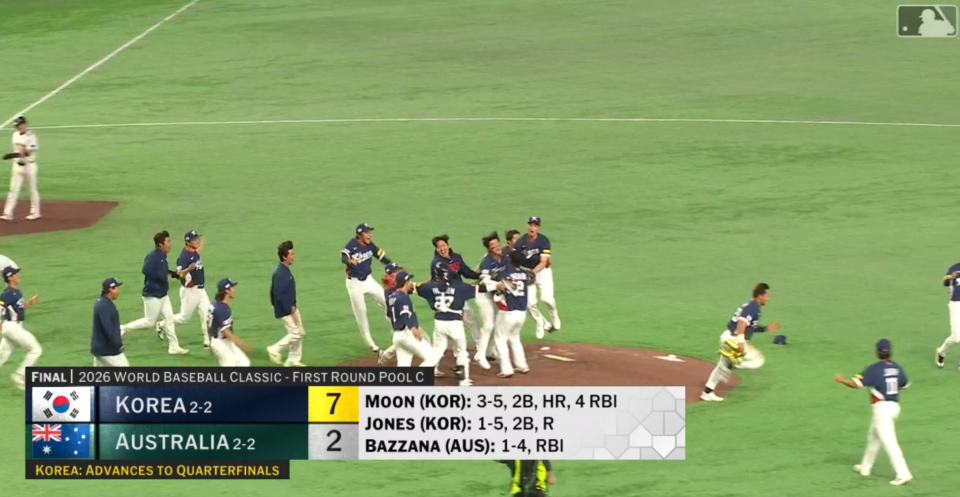
“After Korea’s national team made a surprising run to the quarterfinals, I got so hyped on K-baseball that I decided to look for some quirky baseball games.” 2026-03-12
The Korean national baseball team has advanced to the quarterfinals of the 2026 World Baseball Classic (WBC) in dramatic fashion. Following a 6–8 loss to Japan in the Group C qualifiers and a narrow 4–5 defeat against Taiwan, the team was on the brink of elimination. To advance, they needed to defeat Australia in their final game by at least five runs while allowing no more than two. It was a daunting challenge—one that required everything to go their way.
But they pulled it off. On the 9th, the team defeated Australia 7–2 to secure a dramatic spot in the quarterfinals. This marks the first time Korea has advanced past the WBC group stage in 17 years, since their runner-up finish in 2009. Once again, the Korean team proved their strength when facing tough odds.
Some of the unique games introduced below are available on STOVE, Korea’s largest electronic software distribution (ESD) platform. STOVE supports the growth of Korea’s indie game ecosystem by discovering and introducing high-quality overseas indie titles that are less known locally, while also providing comprehensive support across publishing and operations to help Korean creators stay competitive in the global market.
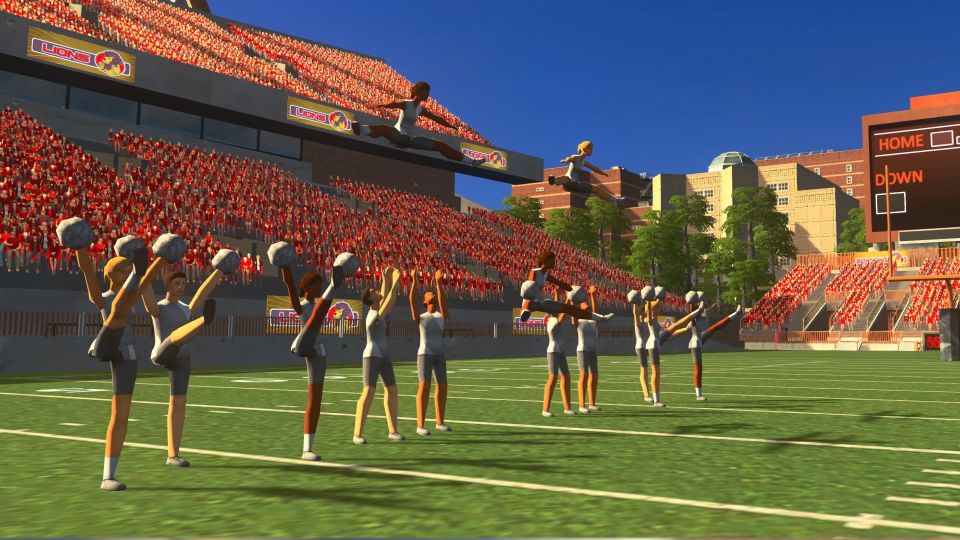
Everyday Baseball VR
There’s no better way to channel that surging baseball fever than by swinging a bat. Everyday Baseball VR is a VR batting game built around home run derbies, offering an immersive experience that makes you feel as if you’re standing in a real stadium.
The grand sense of scale and realistic stadium sounds immediately draw players in. Beyond a simple VR experience, the game also includes swing analysis features, allowing players to check their timing, launch angle, and hit distance. It’s highly accessible, delivering the pure joy of batting.
You can also play this title on STOVE, Korea’s leading indie game store.

Baseball Mogul
Developed by the small studio “Sports Mogul,” this long-running baseball simulation series dates back to 1997. The latest version, Baseball Mogul 25, can be purchased and downloaded directly from the official website.
In Baseball Mogul, you can start with the real-life roster of your favorite team or build a completely fictional team from scratch. You take on the role of a General Manager (GM), with the goal of assembling the best possible roster and leading your team to World Series glory. Along the way, you can engage in complex multi-team trades or sign players to long-term contracts, competing with other GMs and negotiating directly with sports agents.
Your responsibilities extend beyond player management—you must also carefully manage the team’s finances to avoid bankruptcy. This includes setting ticket prices, adjusting concession costs, and generating revenue through TV broadcasting rights. At the same time, you need to control spending by balancing budgets for the farm system, scouting, medical staff, and player salaries. Poor performance or overly high ticket prices can quickly drive fans away.
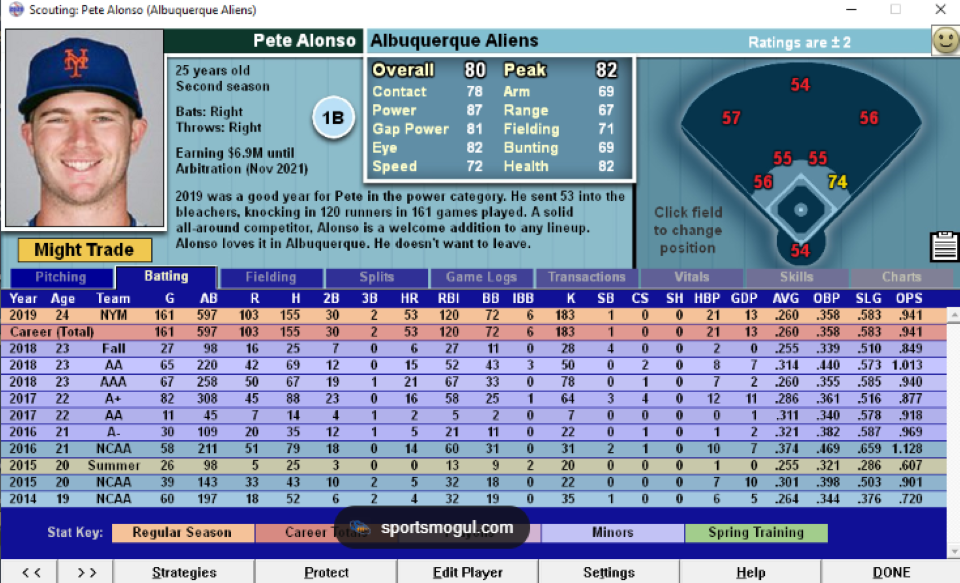
Even if your first season isn’t successful, the Amateur Draft offers another opportunity. You can scout and draft talented high school and college prospects from around the world, then decide whether to call them up to the major league roster or continue developing them in the minor leagues.
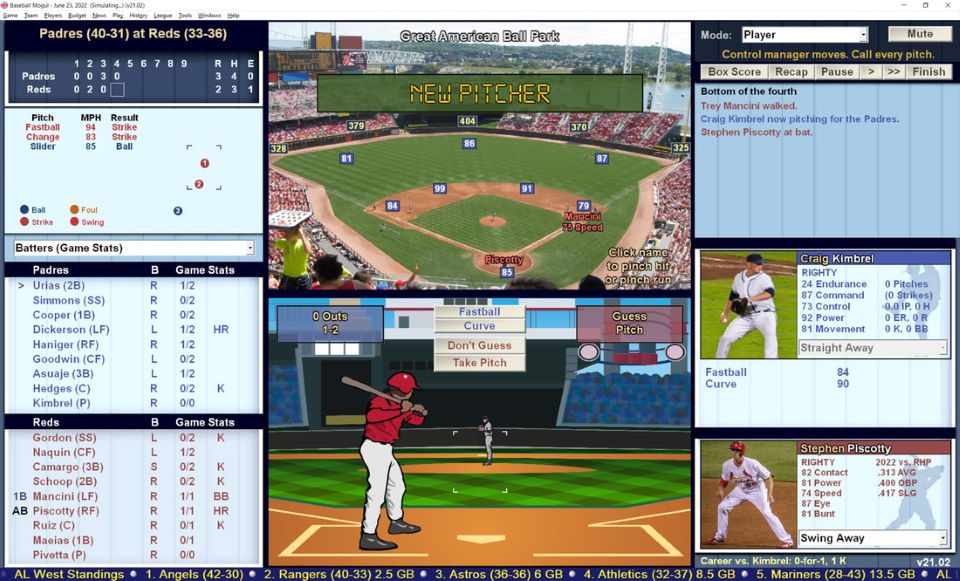
You can also step into the dugout as the manager, setting the starting lineup, batting order, and pitching rotation, while choosing how involved you want to be on game day. Beyond issuing commands, you can take direct control of players—deciding which pitch to throw, when to bunt, or when to push for an extra base. Every pitch is simulated based on detailed player stats and over 100 years of historical data.
Players age, and their performance evolves realistically over time. You’ll need to track your team’s standing, review financial reports, and stay informed through league-wide news. By making smart roster decisions, managing finances effectively, and maintaining a strong strategy, you can fully immerse yourself in the game. If the OOTP series—now far from an indie title—feels too complex, Baseball Mogul offers a more accessible alternative.
Home Run High
Home Run High is a management simulation game where your goal is to lead a newly formed baseball club to a national championship—the legendary Koshien. The developer, Kairosoft, is a small Tokyo-based studio with about ten employees that has been releasing games for nearly 20 years. They are well known for their signature style, applying a familiar management formula to a wide variety of themes.
While Kairosoft games share a similar structure, their appeal is undeniable. As the saying goes, “familiar things are often the hardest to resist.” These games are highly immersive, and once you start, it’s hard to stop. It’s not uncommon to start playing before bed and realize the sun has come up before you know it.
Home Run High follows this addictive formula. Players guide their fledgling baseball team to the national stage by training and developing players based on specific strategies. You can choose to focus on core fitness, prioritize batting power, or strengthen the team’s defense.
You can also build various facilities around the field, such as batting cages and shower rooms. Creating the right training environment improves efficiency, and you can even provide study spaces alongside sports facilities. Once players move into the dormitories, you can eliminate their commute time and manage their specialized diets.
A fun added element is the appearance of Kairosoft’s iconic mascots, such as Kairobot, Chimpan G, and King Ackbar, who bring their signature charm to the game.

Baseball: Breakthrough Gaming Arcade
This is a single-screen 2D arcade game where the goal is simply to catch flying baseballs. Players move left and right to catch the balls and rack up points. Missing even a single ball results in an immediate “Game Over.” The game is all about seeing how high a score you can achieve.
The core gameplay isn’t particularly unusual. What’s truly unique is how the game is released. The small development team behind it, Breakthrough Gaming, releases a new title every Sunday at 6:00 AM EST as part of their “Bible Video Game Sundays” initiative. To date, they have released 223 games. While some titles are split into small episodes or vary only in player count, maintaining a weekly release schedule for over four years is impressive. At this pace, it almost feels like an ongoing series.
Another intriguing element is its Christian theme. The team states that each game is inspired by Bible verses. Baseball: Breakthrough Gaming Arcade is reportedly based on 1 Thessalonians Chapter 5. This chapter is the final part of Paul’s letter to the church in Thessalonica in the New Testament, known for the verses: “Rejoice always, pray without ceasing, give thanks in all circumstances.” How these verses connect to a baseball-catching game remains unclear—but the only way to find out is to play it yourself.

Cities: Skylines – Campus (DLC)
You might be surprised to find a city builder on a list of baseball games. It was included because of the “Varsity” system. The term “Varsity” typically refers to the top-tier sports team representing a school, and is also the origin of the “varsity jacket”—commonly known in Korea as a “baseball jacket.” One well-known origin story traces it back to the “letterman” style worn by the Harvard University baseball team in 1865.
Campus, a DLC for the city builder Cities: Skylines, expands the functionality of universities. In the West, universities often function like small cities, and this DLC reflects that by allowing players to design a university as a fully integrated system rather than just a single building.

Players can establish different types of campuses—such as trade schools, liberal arts colleges, or research universities—attract students, produce academic work, and unlock new buildings to increase their campus’s reputation. As part of this system, university sports management also becomes available. You can create a collegiate sports scene by building stadiums for American football, basketball, baseball, track and field, and swimming. The system involves managing teams, hiring coaches, selling tickets, and earning trophies through victories. Since you can run a varsity baseball team, it’s fair to say the game has a connection to baseball.
On a side note, Colossal Order, the developer of Cities: Skylines, is a small team based in Tampere, Finland. The studio developed Cities in Motion and Cities: Skylines. Despite the success of the first Skylines, it faced criticism for not adequately addressing issues with traffic AI, system bugs, and optimization as it struggled to scale. Cities: Skylines II, released amid these concerns, suffered from similar problems. Eventually, development of the sequel was handed over to Iceflake Studios, while maintenance of the original game was transferred to Tantalus Media. This is often cited as a case study of the growing pains that occur when a small developer scales up too quickly.
Like a Dragon 7 & 8 (Yakuza: Like a Dragon / Infinite Wealth)
There is one tool essential to baseball: the bat. Starting from a slender handle, a bat gradually thickens toward the barrel, ending in a rounded tip. A knob at the end of the handle prevents slipping, while the “sweet spot”—the area that produces the most effective contact—is located on the barrel.
According to professional baseball regulations, a bat must be made of smooth, rounded wood, with a diameter of no more than 2.61 inches (6.6 cm) at its thickest point and a length not exceeding 42 inches (106.7 cm). While ash is commonly used, hickory and birch are also popular choices. Following the influence of Barry Bonds, maple bats once became a major trend.
Recently, the “torpedo bat” has emerged. Its center is thicker than a standard bat, acting as an expanded sweet spot. The New York Yankees, who aggressively adopted this bat, drew attention after scoring 36 runs and hitting 15 home runs over three games against the Milwaukee Brewers in their 2025 opening series. The developer of this bat is reportedly a physics PhD from MIT—showing that baseball is, in many ways, a game of physics.
In the gaming world, there is a character who uses a bat as his primary weapon: Kasuga Ichiban, the protagonist of Like a Dragon 7 and 8. When taking on his unique “Hero” job, he wields a bat wrapped in barbed wire and uses a wide range of skills, from encouraging allies to boosting their abilities.

In the eighth installment, there is a scene where Ichiban—who fought his way through the previous game with a single bat—picks up a bat that had been used as a laundry pole, symbolizing his resolve as he returns to the heart of the conflict. Additionally, Like a Dragon 6 in the same series features a detailed amateur baseball mini-game.
The scene in the eighth installment where Ichiban—who fought his way through the world with a single bat in the seventh—picks up a baseball bat that had been relegated to a laundry drying pole, serves as a powerful symbol of his resolve as he dives back into the heart of the conflict. Additionally, Like a Dragon 6 from the same series features a detailed amateur baseball mini-game.

Yakyuken (野球拳)
It has “baseball” in its name, but it isn’t actually about baseball. Yakyuken, released by Hudson in 1981, was Japan’s first adult-oriented video game. The rules are simple: the player plays Rock-Paper-Scissors (Janken) against the heroine, Megumi. If the player wins, Megumi removes a piece of clothing; if the player loses, their life gauge decreases. The player wins by removing all of the opponent’s clothing, while losing all life results in a “Game Over.”
These rules were not originally created by Hudson. They originated from a traditional local performance and party game in Matsuyama City, Ehime, Japan. Originally, it was a festive activity accompanied by shamisen and taiko drums, involving singing and dancing—and did not include any stripping. It was only after being featured on variety shows that the “loser strips” format became popular nationwide.
There are several theories as to why it’s called "Yakyuken" (Baseball Fist). Some say it refers to choosing between three possibilities, much like a Strike, Ball, or Out. Others believe it started at a post-game party for an amateur baseball team.
Following the release of Yakyuken, Hudson grew into a major player alongside Taito and Tecmo, producing hits like Bomberman, Adventure Island, and Momotaro Densetsu. However, at the time of Yakyuken's development, Hudson was more like a small hardware shop than a professional game studio. They employed Hokkaido University students to develop games and bundled them with computer sales—a start that, by today’s standards, would be considered very "indie."
As similar games followed, this genre became a staple of 1980s Japanese arcades. It evolved into various sub-genres, including "Stripping Mahjong," Pachinko Sexy Reaction (which added Yakyuken mechanics to arcade-style Pachinko), the Gals Panic series (integrating the mechanic into territory-claiming games), and adult-themed Brick Breaker games. Some titles even featured famous adult film or gravure idols. Remarkably, the PSP title All-Star Yakyuken, which saw an official release in Korea, featured top adult video models of the time like Sora Aoi, Yua Aida, and Monburan.
This trend significantly impacted the overall Japanese gaming industry. Once it became clear that adult games were lucrative, companies that are now industry giants—such as Koei, Falcom, and Enix—built their early growth foundations by developing adult-oriented content.
Even after the genre’s decline, its traces remained. The mechanic of destroying female characters' clothing was integrated into fighting games like Art of Fighting 2, leading to the rise of the "Stripping Fighting Game" genre. Today, this legacy continues in systems where costumes are damaged under specific conditions, seen in titles like Bayonetta and NieR: Automata, or in niche series like Gul*Gun where shooting leads to clothing removal.

However, when quoting content in articles, please credit it as “Smilegate Newsroom.”




 TOP
TOP
